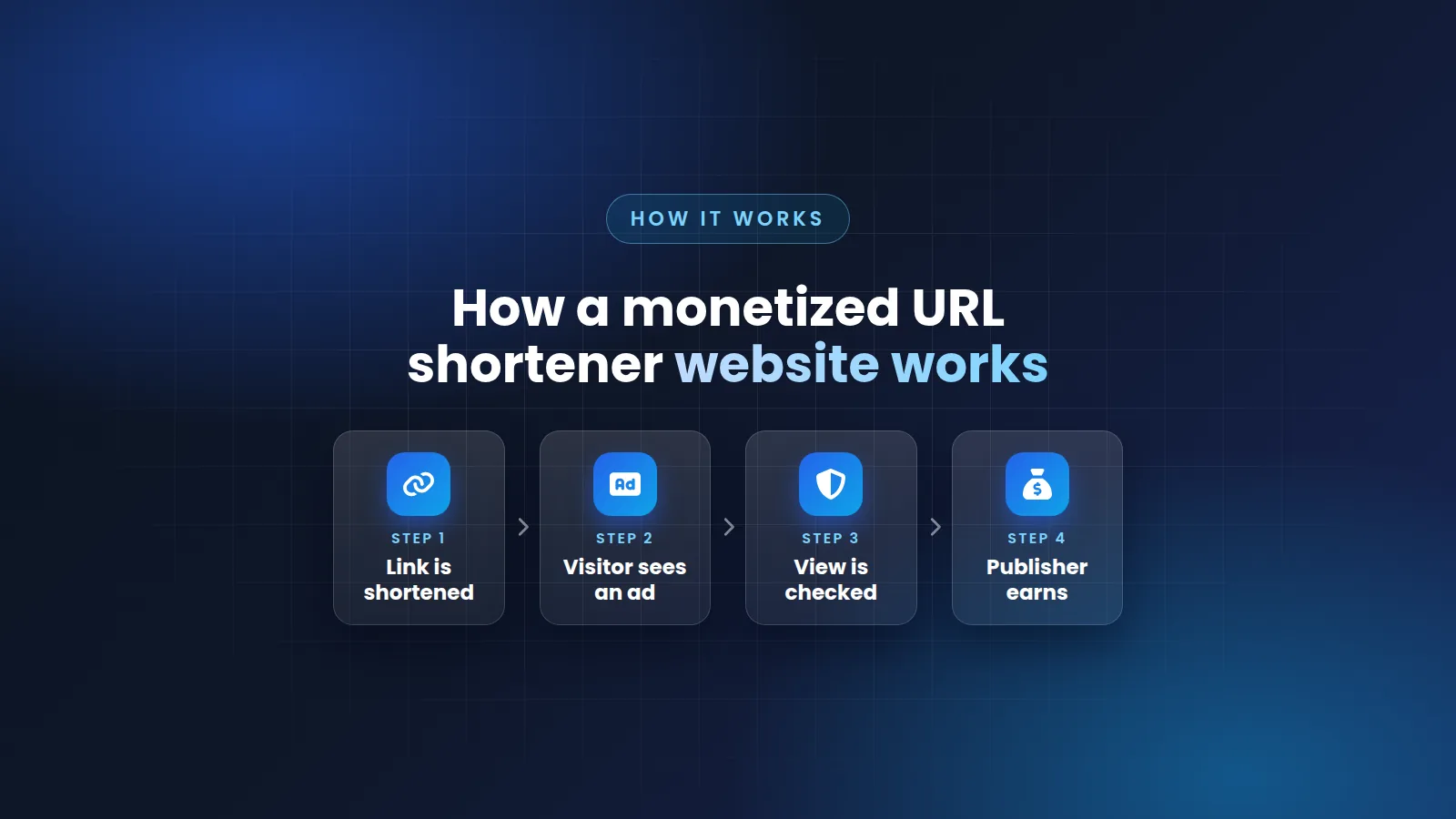
A monetized URL shortener is a link-shortening website. It pays its members for the visitors that their short links get. AdFly and ouo.io made this idea popular. With a self-hosted script such as AdLinkFly, you can run this kind of website on your own domain. You keep full control of it. This guide explains, in simple words, who is involved, how a visit becomes money, and what you need to start.
Who is involved
- Publishers are your members. They shorten links and share them with their audience.
- Visitors click those short links. Before they reach the destination, they see an ad page.
- Advertisers pay to show their ads to those visitors. This happens when you let advertisers buy campaigns.
- You, the site owner, set the rates and rules. You earn money from the ads and pay the publishers.
How a visit becomes money
- A publisher shortens a link. Members make short links one by one, many at once with the Mass Shrinker, or with the Developer API. Then they share them.
- A visitor sees an ad. Before the visitor reaches the destination, an ad page with a short countdown appears. It is a full-page (interstitial) ad or a banner ad. This depends on the publisher's membership plan.
- The visit is checked. Your rules decide if the visit is a qualified view. A qualified view is a real visit that earns money. Examples of rules are a daily limit for each visitor, proxy and ad-blocker detection, and CAPTCHA.
- The publisher earns money. For each qualified view, the publisher earns your CPM rate for the visitor's country. CPM is the amount for 1,000 views.
- The publisher receives the money. When the balance reaches the minimum amount, the publisher asks for a withdrawal. You approve it and send the payment.
Read more: Why did a short-link visit not earn?
Where the money comes from
In AdLinkFly, you choose one of two earning modes:
- Simple mode: You show your own ads, for example from an advertising network. You pay publishers with the payout rates that you set. Members do not need to create campaigns.
- Campaigns mode: Advertisers buy targeted campaigns with full-page, banner, or popup ads. They choose the countries and devices they want, and they pay on your website. Publishers earn money from these campaigns.
In both modes, your income is the ad money. It comes from your advertising network or from the payments of advertisers. Your main cost is the money that you pay to publishers. You can also sell paid membership plans, for example plans with more links or a fixed CPM. Advertising networks and payment providers pay you directly. The money does not pass through the script.
Read more: the difference between Campaigns and Simple modes and how the site owner receives revenue.
Why real traffic matters
Advertisers pay for real visitors. So a monetized URL shortener must block fake visits and repeated visits. AdLinkFly counts all clicks, but it pays only for qualified views. You control the rules:
- A limit on paid views for each visitor IP address each day.
- No earnings from proxy, VPN, or TOR traffic, when proxy detection is enabled.
- No earnings for publishers from visits with an ad blocker.
- Visitors must allow JavaScript and cookies, solve the CAPTCHA (when it is enabled), and wait for the countdown.
- For each click that did not earn, AdLinkFly saves the reason. So you can check why.
Read more: What does "Paid Views Per Day" mean?
Paying your publishers
You can add as many withdrawal methods as you need. Each method has its own minimum amount and instructions. You check every request and mark it as pending, approved, completed, cancelled, or returned. Then you send the payment yourself. You can also pause new withdrawal requests, or export withdrawal data for your records.
Read more: the difference between a withdrawal method and a payment method.
More ways to grow your website
- Referrals: Members earn a percentage when the publishers they invite earn money.
- Membership plans: Free and paid plans with different link limits, countdowns, ad types, and custom domain limits.
- Multiple domains: Many short-link domains, plus custom domains for members.
What you need to start
- A monetized URL shortener script, such as AdLinkFly.
- Hosting that meets the requirements of the script. Read how to choose hosting.
- A domain name. You need more domains if you want several short-link domains.
- Ads: an advertising network for Simple mode, or advertisers for Campaigns mode. Read the rules of the advertising network first. Some networks have rules about URL-shortener traffic.
- Payment methods for plans and campaigns, and withdrawal methods for your publishers.
- Clear terms of use and a privacy policy. AdLinkFly asks new users to accept them when they register.
Is a monetized URL shortener right for you?
Do you want your members to earn money from their links? Then a monetized URL shortener is the right choice. Do you only want branded short links and click statistics? Then a link-management script is the better choice. Read AdLinkFly vs Mighty URL Shortener to compare them.
See it in the AdLinkFly demo: open the full-page ad example or the banner ad example. You can also see AdLinkFly - Monetized URL Shortener. Do you have questions? Ask us before you buy.
Article Details
Explore scripts
Browse available PHP scripts and compare pricing, updates, license access, and support details.
View ProductsNeed guidance?
Send us your questions if you need help choosing the right product for your project.
Contact Support